
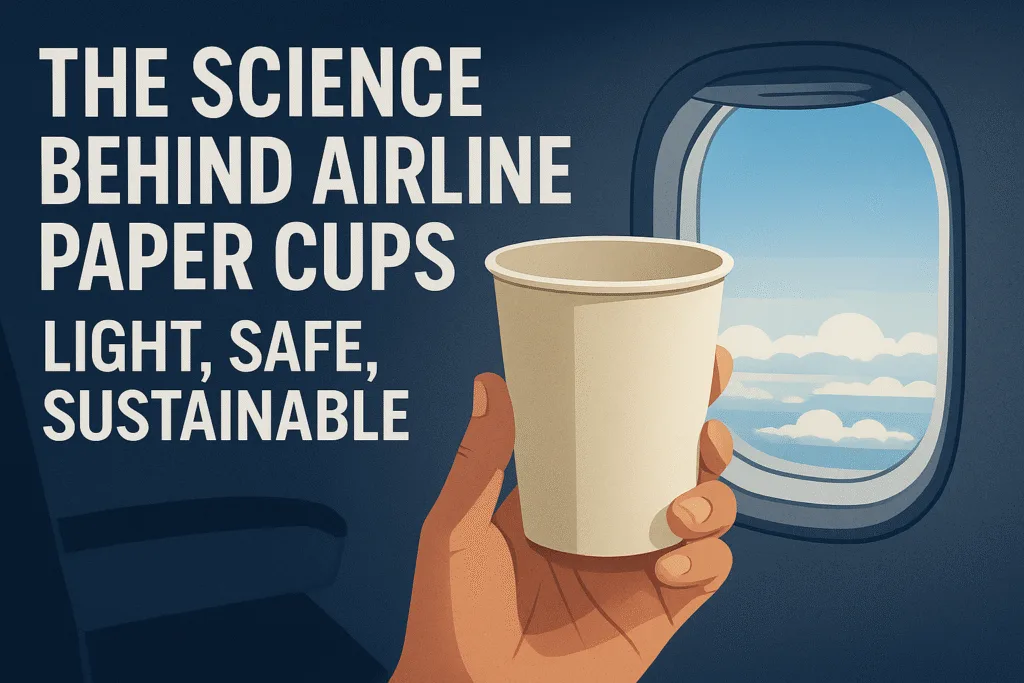
When you’re cruising at 30,000 feet, every gram and every inch of space matter. That’s why airline paper cups are engineered with precision—to be lightweight, stackable, and durable while ensuring safety and passenger comfort. These cups may look simple, but behind their smooth texture and flawless performance lies a combination of material science and smart design.
Unlike standard takeaway cups, airline paper cups must withstand changes in air pressure, limited galley space, and quick service demands. They need to be strong enough to hold hot drinks yet flexible enough to nest neatly for efficient storage. Every curve, coating, and layer serves a purpose—balancing heat resistance, weight reduction, and environmental sustainability.
1. Why Airline Paper Cups Are Different
Every gram matters on an airplane. Airlines look for lightweight, stackable cups that don’t stick together and can be dispensed swiftly. The design must ensure:
Smooth separation between stacked cups for quick service.
Secure lid fit to prevent spills during turbulence.
Compact nesting to maximize trolley and galley space.
A small weight difference per cup might seem trivial, but multiplied across thousands of flights, it can translate into significant fuel savings and reduced emissions.
2. The Role of Coating Technology
Most paper cups rely on an inner barrier to prevent leaks and softening. For aviation, this barrier must deliver three things: durability, smooth surface, and food safety.
Traditional PE coatings have long dominated the industry but create recycling challenges. PLA coatings—though plant-based—require industrial composting facilities that are not available in most airports.
That’s why many airlines and manufacturers now prefer PFAS-free aqueous (water-based) coatings, which:
Offer a smooth, non-sticking surface for easy cup separation.
Maintain reliable barrier performance for both hot and cold drinks.
Improve recyclability within standard paper recycling streams (depending on local facilities).
At Tiptopak, our water-based barrier cups combine functionality with sustainability, meeting the performance standards airlines demand while reducing plastic waste.
3. Heat and Cold Resistance: Tested at Cruising Altitude
An airline paper cup must perform across temperature extremes. Hot beverages can reach 85–90 °C, while cold drinks and alcohol may cause condensation on the cup exterior.
A well-engineered cup uses:
High-stiffness paperboard to prevent deformation.
Precision rim rolling for lid compatibility and passenger comfort.
Optional surface embossing to improve grip under cold conditions.
These performance details ensure that one design can safely handle multiple beverage types during flight—minimizing inventory complexity for the airline.
4. Production and Quality Control
Airline suppliers face strict specifications. Weight, sealing strength, and leak resistance are closely monitored. Automated forming lines use ultrasonic or heat sealing, followed by air or water leak tests on random samples.
Consistency matters: even small variations in thickness or rim diameter can cause stacking issues or lid leakage at altitude.
Manufacturers like Tiptopak conduct:
Material stability tests under temperature and pressure simulation.
Stack friction coefficient checks to optimize easy separation.
Compliance reviews to ensure food safety (FDA, LFGB, etc.).
5. The Sustainability Imperative
The aviation industry is under mounting pressure to reduce single-use plastics. Airlines like Delta and Qantas have publicly committed to eliminating millions of plastic cups each year by switching to paper alternatives.
However, “eco-friendly” solutions must be practical too. Aqueous-coated cups are an excellent step forward—provided the ground facilities at destination airports can recycle or compost them effectively. Without proper infrastructure, even the greenest materials may still end up as landfill waste.
That’s why collaboration between manufacturers, airlines, and waste processors is essential to close the loop.
Final Thoughts
Designing an airline paper cup means balancing form, function, and environmental responsibility. It’s not just about preventing leaks—it’s about engineering a lightweight, stackable, heat-resistant, and recyclable product that performs flawlessly at 30,000 feet.
At Tiptopak, we specialize in water-based coated paper cups that meet these exacting standards. Whether for airlines, inflight catering, or sustainable hospitality brands, our solutions are engineered to perform—and designed for the planet.

