
A comprehensive guide to navigating Western Australia’s new regulations and securing your HORECA supply chain against fines.
Western Australia (WA) currently enforces some of the most aggressive packaging regulations globally. If your business is sourcing plastic ban paper cups, you face a critical compliance gap. The state’s progressive Plan for Plastics targets a complete phase-out of non-recyclable materials. While many procurement managers assumed PLA (Polylactic Acid) was the ultimate sustainable solution, real-world enforcement proves otherwise. Businesses must urgently pivot to Aqueous Coating to ensure market access.
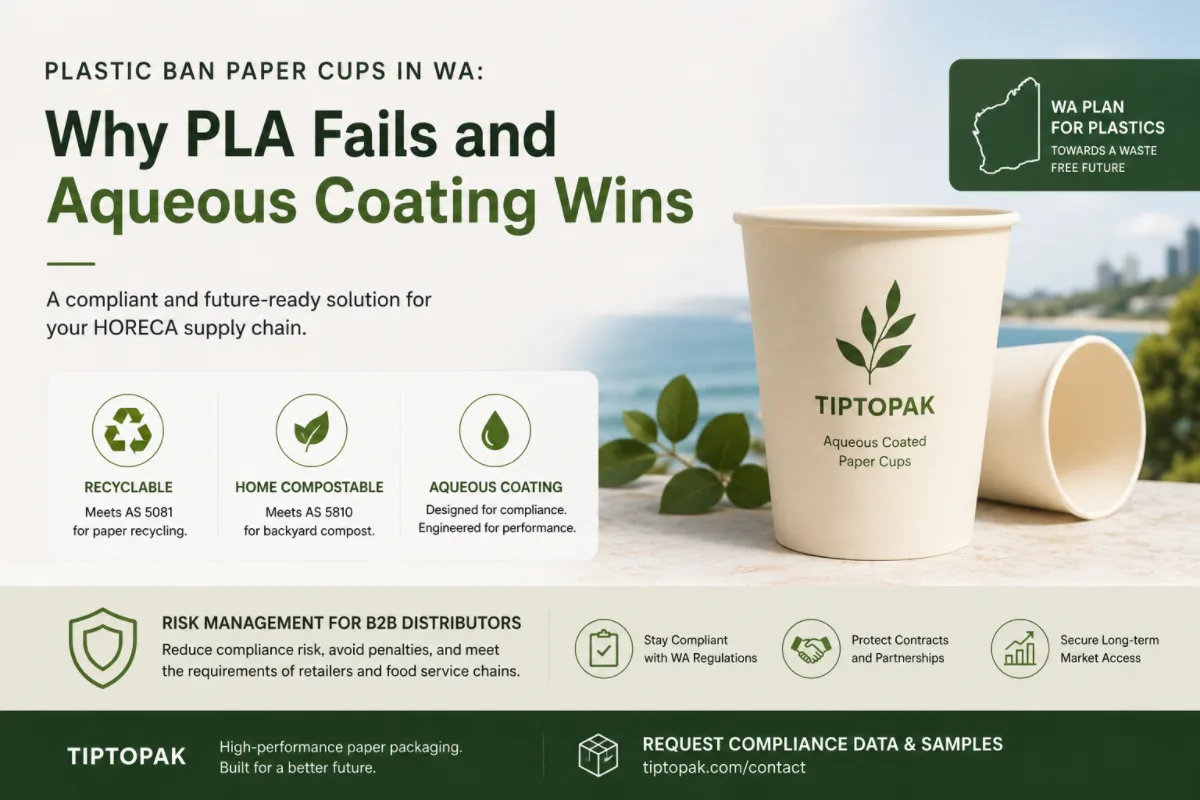
Aqueous coated cups: The compliant solution for WA’s strict regulations.
Unpacking the “PLA Trap”: The Infrastructure Mismatch
Historically, manufacturers marketed PLA as a perfect “green” alternative. However, its degradation requires highly specific industrial conditions. Western Australia’s environmental regulators identified a fundamental flaw in this supply chain logic: Severe Infrastructure Mismatch.
Most regional councils in WA lack the large-scale industrial composting facilities necessary to process bioplastics. These facilities must reach and sustain temperatures above 60°C (140°F) to break down PLA effectively. Therefore, when consumers discard PLA into standard bins, it ends up in conventional landfills, releasing methane as it decomposes. Consequently, the WA government classifies industrial-compostable plastics as “problematic waste.”
The Aqueous Solution for Plastic Ban Paper Cups
To survive the market transition, suppliers must align with local waste management capabilities. The WA Plan for Plastics heavily prioritizes materials that meet Recyclability (AS 5081) and Home Compostability (AS 5810) standards. Aqueous Coating aligns perfectly with these strict legal frameworks.
Unlike traditional PE or PLA, which manufacturers laminate onto paper as a solid plastic film, Aqueous Coating utilizes a different physical mechanism. Engineers disperse specialized polymers into a water base and apply them directly to the paper fibers.
- ✔
Unmatched Repulpability: Aqueous coated products can enter standard paper recycling mills without clogging the pulping screens, achieving a true closed-loop cycle. - ✔
Ambient Degradation: Advanced water-based coatings frequently meet strict AS 5810 standards, breaking down in standard backyard compost bins.
Risk Management for B2B Distributors
Operating within the Australian market without precise material compliance represents a catastrophic risk strategy. The WA Department of Water and Environmental Regulation (DWER) holds the authority to issue substantial financial penalties for distributing non-compliant single-use items.
Furthermore, retail giants and national food chains are actively conducting aggressive Supply Chain Audits. These corporations demand undeniable proof of recyclability and verified third-party certifications from all upstream vendors. Upgrading to Aqueous Coating acts as a critical financial hedge against regulatory cargo seizure and sudden contract terminations.

