
For buyers searching for recyclable paper cups, the answer is more complicated than simply “yes” or “no.”
Many paper cups are made mainly from paperboard, but they also contain a thin polymer coating. This coating helps prevent leakage, resist heat and protect the cup from liquids. At the same time, it can affect how easily the paper fibers are separated during the recycling process.
A paper cup may be designed for recycling, but that does not automatically mean it will be accepted by every collection program or paper mill. The final result depends on the cup structure, coating system, recycling technology and local infrastructure.
What Does the New US Paper Cup Recycling Guide Say?
On September 15, 2026, the Poly Coated Paper Alliance (PCPA) released a US industry guide focused on the design recyclability of polymer-coated paper packaging.
The guide covers several commonly used food and beverage packages, including:
- Coffee cups
- Milk and juice cartons
- Ice cream containers
- Other poly-coated food packaging
According to the announcement, the guide was developed using feedback from paper mills in the United States and Canada. The research represents more than 90% of consumption in the relevant recovered-fiber grades.
This is significant because it connects packaging design decisions with the actual requirements of recycling mills.
Four Compatibility Categories for Poly-Coated Paper Packaging
The PCPA guide uses four compatibility categories:
| Category | General Meaning | What Buyers Should Understand |
|---|---|---|
| Fully Compatible | The packaging is compatible with the relevant recycling process under the guide’s evaluation framework. | The design has a stronger basis for a recyclability claim. |
| Conditionally Compatible | Compatibility depends on certain material limits, process conditions or market requirements. | The claim should clearly state the conditions. |
| Not Compatible | The packaging may create problems for the relevant recycling process or finished fiber quality. | The design may need to be changed. |
| Unknown | Available evidence is not sufficient to determine compatibility. | Additional testing should be requested before making a claim. |
These classifications describe packaging compatibility at the recycling-mill level. They do not guarantee that every local curbside collection program will accept the product.
What Makes Recyclable Paper Cups Work?
1. Coating type and coating amount
The coating is one of the most important factors affecting paper cup recycling.
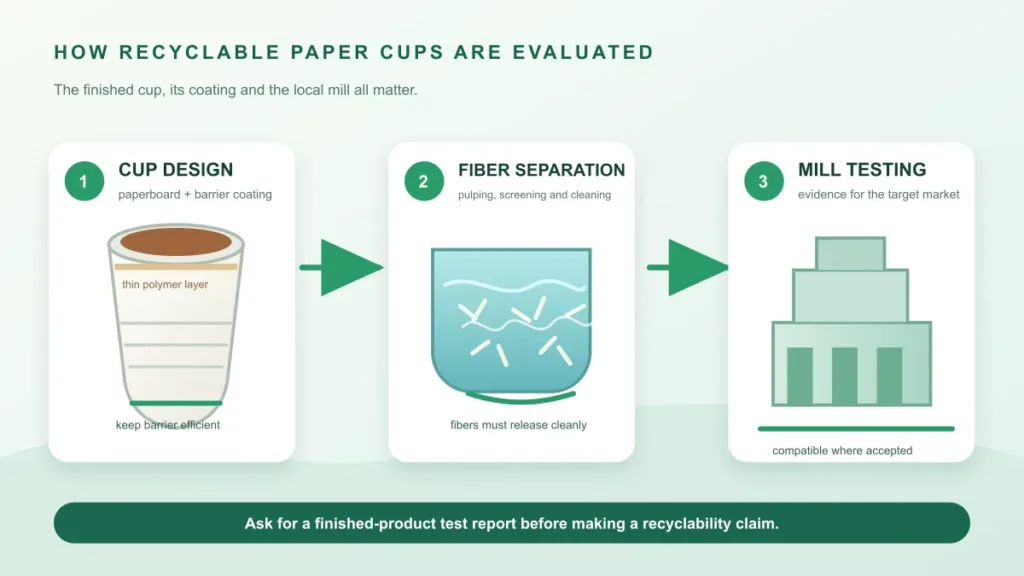
A barrier coating must protect the cup from water, coffee, milk, oil or frozen products. However, it must also allow the paper fibers to separate during pulping. A coating that is difficult to remove may increase rejects, interfere with screening or reduce the quality of recovered fiber.
The amount of coating also matters. Two cups may use similar paperboard but have different recycling performance because of differences in coating weight, coverage or application method.
2. Fiber separation during pulping
Paper mills use water, agitation, screening and cleaning equipment to separate useful paper fibers from non-fiber materials.
For a coated cup to be recycled successfully, the paper fibers should be released efficiently. If the coating, adhesive or other components remain attached to the fibers, the material may be harder to process.
This is why a paper cup cannot be evaluated by looking only at its paper content. The complete package must be tested.
3. Cup structure and additional components
The cup body is only one part of the package. Other components may affect recyclability, including:
- Inks and printing coverage
- Adhesives used in the side seam
- Plastic lids
- Sleeves and labels
- Handles or attached accessories
- Multiple layers of barrier materials
A simple cup structure may be easier to process than a package containing several different materials. Finished-product testing is therefore more useful than evaluating the paperboard alone.
4. Local collection and mill capabilities
A cup can be technically compatible with a recycling process but still be unavailable for collection in a particular region.
Recycling systems differ between countries, cities and paper mills. Some facilities may accept selected foodservice packaging, while others may not have the equipment or market demand to process it.
For this reason, recyclability claims should identify the target market and the conditions under which the claim applies.
How Can Buyers Verify a Recyclable Paper Cup Claim?
A supplier’s use of the word “recyclable” should be supported by specific technical information. Buyers can ask the following questions:
- Which recycling system or paper mill was used for the evaluation?
- Was the complete finished cup tested, or only the paperboard?
- What coating type and coating percentage were used?
- Were the inks, adhesives, lids and sleeves included in the test?
- Which test method or industry guideline was followed?
- Was the result classified as fully compatible, conditionally compatible, not compatible or unknown?
- What are the limitations of the test?
- Is the test report current and applicable to the production specification?
A credible report should identify the tested product, material structure, test conditions, date, testing organization and limitations.
A general environmental logo or a statement such as “eco-friendly paper cup” is not enough to prove that the package is accepted by a recycling mill.
Design Recommendations for Paper Cup Manufacturers
Manufacturers and brands can improve the quality of their recyclability claims by taking several practical steps:
Define the target market first
The best cup design for one market may not be suitable for another. Packaging specifications should be developed around the collection systems and paper mills available in the destination market.
Test the finished product
Testing only raw paperboard does not capture the effect of printing, adhesives, forming and other production processes. The final cup should be evaluated in its commercial form.
Balance barrier performance with recyclability
The coating must provide the required protection for hot drinks, cold drinks, oily foods or frozen products. At the same time, unnecessary coating weight and excessive material layers should be avoided.
Document the material structure
Keep records of the paperboard grade, coating chemistry, coating weight, ink system, adhesive and production specification. This makes it easier for buyers to verify the claim and maintain consistency between samples and mass production.
Communicate disposal conditions clearly
Where recycling depends on local acceptance, brands should use accurate wording such as:
“Designed for recycling where accepted by local collection and recycling facilities.”
This is more precise than suggesting that every paper cup can be recycled everywhere.
What Does This Mean for Paper Cup Buyers?
The new US guidance gives procurement teams a clearer way to compare paper cup suppliers.
Instead of asking only whether a cup is “green” or “recyclable,” buyers can ask:
- What is the complete material structure?
- Which recycling process was used for testing?
- What coating and fiber-separation results were recorded?
- Is the product fully or conditionally compatible?
- Does the claim apply to the target country?
- Can the supplier provide a current test report?
This approach helps buyers select packaging based on evidence rather than general marketing language.
For coffee cups, paper bowls and other foodservice packaging, Tiptopak can discuss material structures and product requirements according to the intended application and target market. Contact our packaging team to review your paper packaging project.
Frequently Asked Questions
Are all paper cups recyclable?
No. Some paper cups may be compatible with recycling processes, while others may require specific conditions or may not be compatible with the available mill system.
Why are paper cups difficult to recycle?
Most paper cups contain a barrier coating that protects the paperboard from liquids. During recycling, the coating must be separated from the paper fibers efficiently.
Is a PLA-coated paper cup automatically recyclable?
No. PLA or another bio-based coating does not automatically guarantee recyclability. The finished cup must be evaluated against the requirements of the target recycling system.
How can I verify a supplier’s recyclable paper cup claim?
Ask for a test report covering the finished cup, including its paperboard, coating, inks, adhesives and other components. Also confirm whether the result applies to your target market.
Conclusion
Paper cups can be recyclable when their complete material structure is compatible with an appropriate recycling process and when local facilities accept them.
The 2026 PCPA guide provides a more practical framework by classifying polymer-coated paper packaging as fully compatible, conditionally compatible, not compatible or unknown. For buyers and manufacturers, the key lesson is clear: a credible recyclability claim should be supported by finished-product testing, transparent specifications and market-specific evidence.

