
Introduction
For years, sustainability discussions focused on a single question: How can we replace plastic?
Today, the conversation has evolved.
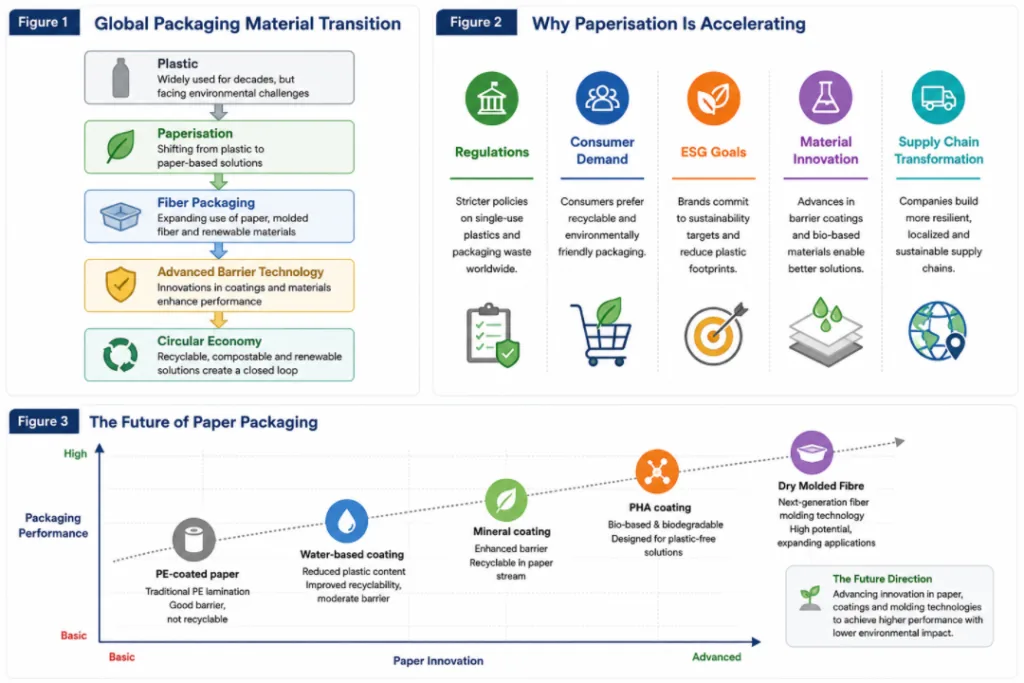
Across Europe, North America, and Asia-Pacific, brands are increasingly embracing paperisation—the transition from plastic packaging to fiber-based alternatives. From supermarket trays to takeaway containers and beverage cups, paper is becoming the preferred material for many applications.
However, replacing plastic with paper is not as simple as changing materials. Every packaging decision involves trade-offs in barrier performance, manufacturing efficiency, recyclability, and cost.
So, is paperisation the future of sustainable packaging—or does it introduce a new set of challenges?
What Is Paperisation?
Paperisation refers to the ongoing transition from plastic packaging to paper- and fiber-based alternatives wherever technically feasible.
Unlike a simple material substitution, paperisation represents a broader shift in packaging design, manufacturing, and supply chain strategy.
The trend is driven by several factors:
- Government restrictions on single-use plastics
- Corporate sustainability commitments
- Consumer demand for recyclable packaging
- Advances in barrier coating technologies
- Improvements in paper manufacturing
For many brands, paper is no longer viewed as just an environmentally friendly option—it has become a strategic business decision.
Why Is Paperisation Accelerating?
Several global trends are driving the rapid adoption of paper packaging.
- Regulatory Pressure
Governments worldwide continue introducing stricter regulations on plastic waste.
The European Union’s Single-Use Plastics Directive, Extended Producer Responsibility (EPR) schemes, and packaging waste reduction targets are encouraging companies to redesign packaging with recyclable materials.
Many multinational brands are therefore evaluating paper-based alternatives across their product portfolios.
- Consumer Expectations
Consumers increasingly associate paper packaging with sustainability.
Research consistently shows that paper enjoys one of the highest consumer trust levels among packaging materials due to its recyclability and renewable origin.
Although perception alone should not determine packaging choices, it has become an important marketing advantage.
- Corporate ESG Goals
Large foodservice companies are under growing pressure to reduce virgin plastic consumption.
Many brands have announced ambitious packaging targets, making paperisation a key part of their environmental strategies.
The Hidden Challenges Behind Paperisation
Despite its momentum, paperisation is far from straightforward.
Replacing plastic requires solving several technical challenges.
Barrier Performance
Plastic naturally provides excellent protection against:
- water
- grease
- oxygen
- moisture
Paper does not.
To achieve similar performance, manufacturers rely on advanced barrier technologies such as:
- water-based coatings
- mineral coatings
- bio-based coatings
- PHA coatings
In many applications, the coating—not the paper—determines packaging performance.
Manufacturing Complexity
Switching from plastic to paper often requires redesigning production lines.
Paper behaves differently during:
- forming
- sealing
- printing
- heat resistance
As a result, successful paperisation depends on both material science and manufacturing expertise.
Cost Considerations
Although paper is renewable, paper-based packaging is not always cheaper.
Manufacturers must balance:
- material costs
- coating technology
- converting efficiency
- transportation costs
- recycling requirements
The most sustainable solution is not always the lowest-cost option.
Why Barrier Technology Matters More Than Ever
One of the biggest misconceptions about paperisation is that the paper itself solves the sustainability challenge.
In reality, the future of paper packaging depends heavily on barrier technology.
Modern food packaging increasingly requires coatings that can:
- resist water and grease
- maintain heat-sealing performance
- remain recyclable or compostable
- comply with evolving food-contact regulations
This explains why innovations in water-based coatings, mineral coatings, and biodegradable polymers such as PHA are attracting significant industry attention.
The future competition is shifting from paper quality to functional barrier performance.
Will Paper Replace Plastic Completely?
Probably not.
Plastic still offers advantages in applications requiring:
- extremely high moisture barriers
- long shelf life
- complex flexible packaging
Instead of complete replacement, the industry is moving toward application-specific material selection.
Paper will continue expanding into categories where its environmental benefits outweigh technical limitations.
What This Means for Paper Packaging Manufacturers
For manufacturers, paperisation creates significant opportunities—but also raises expectations.
Customers are no longer looking only for paper products.
They expect suppliers to provide:
- advanced barrier technologies
- regulatory compliance
- recyclable solutions
- customization capabilities
- reliable global supply chains
Innovation is becoming a competitive advantage rather than an option.
Looking Ahead
Paperisation is more than a temporary trend—it represents a long-term transformation of the packaging industry.
However, success will not depend simply on replacing plastic with paper.
It will depend on developing smarter materials, better coatings, and more efficient manufacturing technologies that deliver both sustainability and performance.
For companies investing in next-generation paper packaging, the greatest opportunity lies not in changing the material alone, but in redefining what paper can achieve.
Conclusion
Paperisation is opening new opportunities across the global packaging industry, but it also highlights the importance of innovation beyond the paper substrate itself.
At Tiptopak, we believe the future of sustainable food packaging lies in combining high-quality paper with advanced barrier technologies—including water-based, mineral, and bio-based coating solutions—to deliver packaging that is practical, compliant, and environmentally responsible.

